More Content Isn’t Better Content
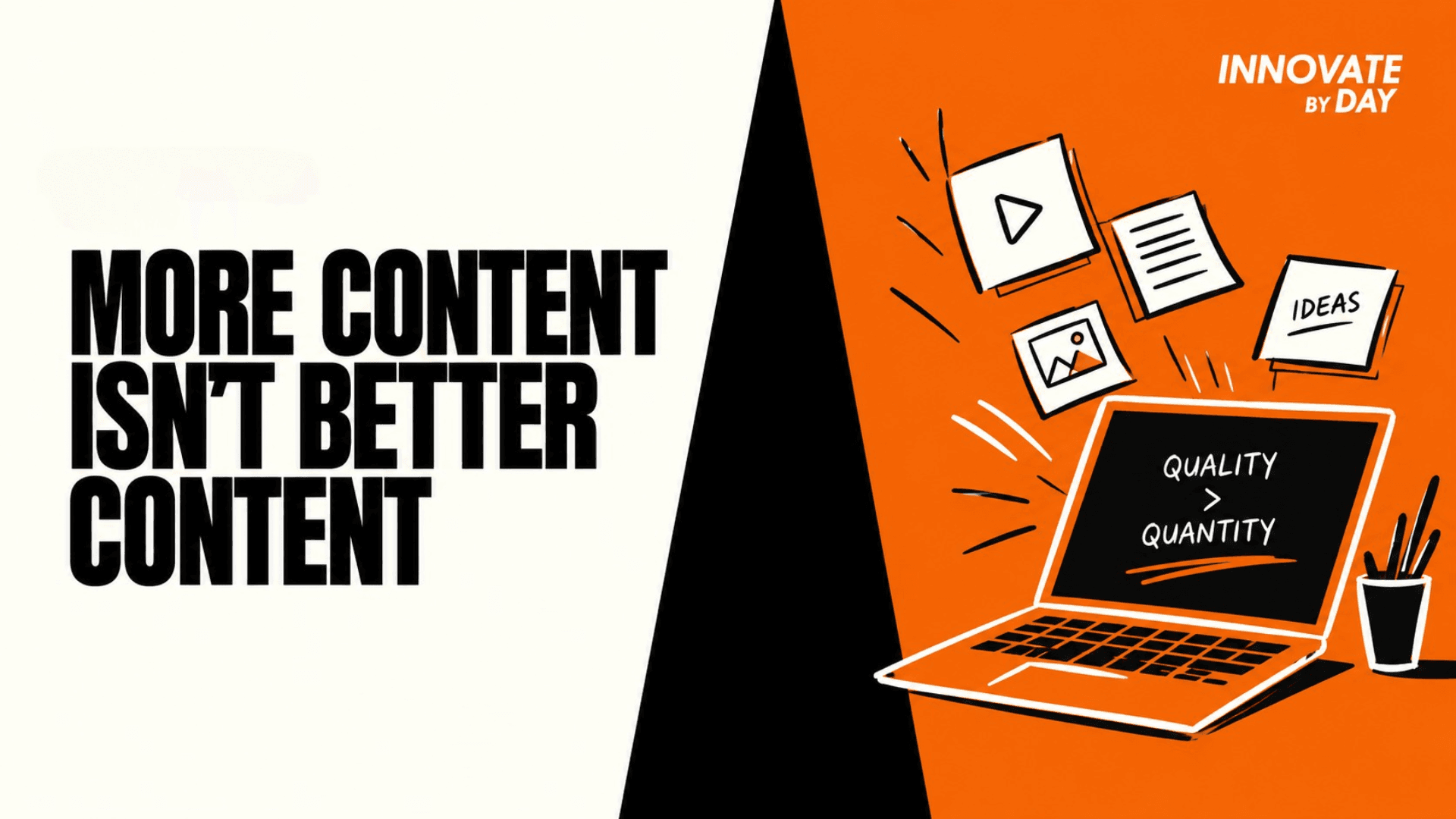
More content isn’t always better. Learn how a clear content strategy can help your organization plan with purpose, stay consistent, and get more value from every idea.
Most content calendars don’t start out feeling overwhelming.
A few posts become a few more. Then there’s a campaign to support, a blog to promote, a video to create, an event to cover, a trend to respond to, and a new platform to consider.
Before long, the calendar is full. This can look like momentum. But a busy content schedule doesn’t necessarily mean your content is working harder for your organization.
At Innovate By Day, we like to start somewhere simpler:
What does this content need to do?
That question helps bring everything else into focus: the audience, the message, the format, the platform, the call to action, and the role each piece plays in the bigger picture.
Start With the Role Your Content Needs to Play
Every piece of content should have a reason to exist.
A blog might demonstrate expertise in greater depth. A short video can make a complex idea easier to understand. A social post may introduce someone to your organization for the first time. An FAQ can help someone who is already interested find the information they need to take the next step.
Those pieces can all belong to the same strategy while serving very different purposes.
That’s why we like to begin content planning with a few simple questions:
- What are we hoping to accomplish?
- Who are we speaking to?
- What would be genuinely useful or interesting to them at this point?
- Where does this piece fit within the larger experience we’re creating?
The answers give the creative team something valuable to work with. They help shape the message, tone, format, platform, and call to action.
They can also make it easier to recognize which ideas deserve more attention, and which ones probably don’t need to become content at all.
Give Good Ideas Room to Grow
Content planning can make it seem like every empty space on the calendar requires a brand-new idea.
It doesn’t.
Some of the strongest content strategies spend more time with the ideas that are already proving useful.
Think about a question that comes up regularly in client conversations. It might begin as an FAQ on your website. That same question could inspire a longer article that explores the subject in greater depth. A takeaway from the article could become a short video, while another could become a carousel, LinkedIn post, newsletter topic, or conversation starter.
The goal isn’t to repeat the same message everywhere. It’s to explore a strong idea from different angles and in formats that suit how different people prefer to engage.
We’ve been taking this approach with our own content at Innovate By Day. A larger monthly theme gives us several related questions to explore across our blog, social channels, FAQs, and video content.
It creates continuity without requiring every piece to say exactly the same thing.
It also gives ideas more opportunities to find their audience. Someone may scroll past a blog link and stop for the Reel. Another person may save the carousel. Someone else may arrive months later through a search question that leads them to the FAQ.
That’s part of the value of thinking beyond the individual post.
People inside an organization know the questions clients ask. They know which messages have resonated in the past, which language feels natural, which topics require more sensitivity, and which phrases would never sound right coming from the brand. But an AI tool doesn’t automatically have that context.
That’s why protecting brand voice requires more than adding “make this sound like us” to the end of a prompt. Someone on the team still needs to understand what “us” means and recognize when the result doesn’t quite hit the mark.
We see this too often. A sentence can sound perfectly professional but still miss an important nuance: it may assume too much knowledge from the audience, use language the organization has deliberately avoided, overlook an accessibility consideration, or simply not sound like something a client would ever say.
That is the difference between content that checks the boxes and content that actually belongs to the organization behind it.
Build a Rhythm Your Team Can Sustain
There is no universal posting schedule that works for every organization.
Once your purpose and content priorities are clear, frequency becomes much easier to determine.
Audience behaviour matters. So do campaigns, internal resources, approval processes, available stories, production capacity, and how much time a team can realistically dedicate to creating, publishing, and managing content well.
A sustainable rhythm gives teams enough time to develop ideas thoughtfully, maintain quality, respond to what is happening around them, and learn from what they publish.
It also creates space for one of the most important (and most overlooked) parts of digital communication: listening.
Make Space for the Conversation
Publishing is only one part of having a digital presence.
Comments, questions, emails, campaign responses, website behaviour, client conversations, and community feedback all tell us something about what people are interested in, confused by, responding to, or looking for next.
Those signals are content strategy.
A question in the comments might reveal a topic that deserves its own post. A conversation with a client could surface an assumption worth clarifying. A blog that keeps attracting readers months after publication may point to an area where people are actively searching for guidance.
When the plan has flexibility, those insights can shape what comes next.
This is particularly important on social media, where the social part can easily get lost in the pressure to maintain a publishing schedule.
Strong communities aren’t built through broadcasting alone. They develop through interaction: asking, responding, observing, participating in the conversation, and paying attention.
Content gives people something to engage with. What happens around that content can be just as valuable as the content itself.
Think About the Whole Digital Journey
Content also becomes more powerful when we think about what happens after someone sees it.
Imagine someone discovers your organization through a Reel. They become curious and visit your website. From there, they might read an article, visit a service page, explore a resource, register for an event, subscribe to an email list, watch another video, or reach out.
That Reel wasn’t an isolated piece of content. It was an entry point.
That’s why we think about content as part of an organization’s broader digital presence. Social media, websites, search, email, video, advertising, and other channels work harder when they are connected by a clear strategy and a consistent story.
Clear messaging helps people understand who you are.
Useful information gives them a reason to keep exploring.
Thoughtful calls to action make the next step easier to find.
Looking at the full journey gives content teams a much stronger foundation for deciding where to invest their time, and where another post probably isn’t the answer.
Let Your Priorities Shape the Calendar
An organization’s priorities naturally change throughout the year.
There may be a campaign to launch, an event to support, a new service to introduce, a community to engage, an issue to explain, a story that deserves more attention, or a business objective that suddenly becomes more important.
A useful content calendar should reflect those priorities rather than compete with them.
It can also help teams build a healthy mix of communication: educational content that shares expertise, stories that introduce the people behind the work, resources that answer questions, campaign content that encourages action, and posts designed to start conversations.
Over time, that mix helps people build a fuller understanding of an organization.
It also changes the planning conversation.
Instead of beginning each week with an empty box and asking, “What should we post?”, teams can begin with a more valuable question:
“What do we need to move forward?”
That shift makes content planning much more intentional.
Measure With Purpose
Clear objectives matter just as much after content has been published.
Not every piece of content should be measured against the same metric.
A post created to encourage conversation may be evaluated through comments, responses, and the quality of engagement. A resource designed to answer a common question may prove more valuable because people continue finding it through search months later. A campaign landing page might have a very specific conversion goal.
Performance only becomes meaningful when we consider what the content was designed to accomplish.
That context helps teams understand not only what is performing, but why.
One topic may consistently generate thoughtful discussion. Audiences may spend more time with video than expected. An FAQ might continue attracting search traffic long after it was published. A campaign may reveal that one message resonates much more clearly than another.
Those insights should inform what happens next.
Because content strategy isn’t a calendar you finish.
It’s a cycle: create, listen, learn, and adjust.
Final Thought: Create With Reason
There will always be another idea to explore, another trend to react to, and another platform where your organization could be publishing.
That’s part of what makes digital communication exciting.
It’s also why strategy matters.
A clear content strategy gives teams a shared understanding of what they are trying to accomplish. It creates a foundation for choosing the ideas, formats, and channels that deserve attention and gives teams permission to leave the rest behind.
It also creates more room for creativity, not less, because the people doing the work understand what the content is there to achieve.
At Innovate By Day, we believe some of the strongest content begins well before anyone writes a caption, opens a design file, or presses record.
It begins with curiosity!
What are we trying to move forward?
Who are we trying to reach?
What would be useful, meaningful, or interesting to them?
Those questions can lead to fewer rushed decisions, stronger ideas, better stories, and a content plan that works together instead of simply filling a calendar.
Because more content isn’t necessarily better content.
More purposeful content is.
If your team is looking for a fresh perspective on its content and digital strategy, explore our services or contact us to start the conversation.
- Share on Linkedin
- Share on Facebook
- Share on Twitter
Share this blog
Related Posts
More Content Isn’t Better Content
Posted on Tuesday September 22, 2026 by Sharon McDonald
How to Use AI Without Losing Your Brand Voice
Posted on Thursday August 20, 2026 by Sharon McDonald
Accessibility Isn’t an Add-On: The Importance of an Inclusive Digital Strategy
Posted on Thursday July 23, 2026 by Sharon McDonald
Spring Cleaning Your Digital Presence: Small Updates That Build Stronger Brand Trust
Posted on Thursday May 28, 2026 by Sharon McDonald
Strategic Storytelling: Why Every High-Impact Video Starts with a Creative Brief
Posted on Tuesday March 31, 2026 by Sharon McDonald
Critical Thinking is AI’s Kryptonite
Posted on Monday March 23, 2026 by Deb Day
The CEO’s Guide to AI Governance: Why We Can’t Wait for Ottawa
Posted on Friday February 6, 2026 by Deb Day
The Audience-First Shift: What the CRTC Discoverability Study Means for You
Posted on Tuesday January 27, 2026 by Sharon McDonald
2026 Digital Marketing Trends: What Brands Need to Know for the Year Ahead
Posted on Wednesday January 14, 2026 by Sharon McDonald
How Purpose-Driven Work Has the Power to Drive Productivity
Posted on Thursday November 27, 2025 by Mandy Tse
What It Means to Be a Purpose-Driven Digital Marketing Agency
Posted on Thursday November 28, 2024 by Jessica Mendoza
Make Your Digital Content Accessible: What You Need to Know About Accessibility
Posted on Thursday May 16, 2024 by Jessica Mendoza
Debunking Marketing Myths
Posted on Monday April 22, 2024 by Jessica Mendoza
Social Media Marketing Predictions 2024: Embracing the Future While Maintaining the Classics
Posted on Thursday January 18, 2024 by Jessica Mendoza
Embracing the Future: The Impact of Artificial Intelligence in Digital Marketing
Posted on Tuesday November 7, 2023 by Jessica Mendoza
Exploring the Top Twitter Alternatives in 2023
Posted on Friday July 14, 2023 by Jessica Mendoza
Social Media During Black History Month
Posted on Thursday February 23, 2023 by Selina McCallum
What to do when the hate comments start rolling in?
Posted on Wednesday October 12, 2022 by Teagan Lisson
Get your brand marketing on track
Posted on Wednesday November 17, 2021 by James Woods